How to Create a Perfect Landing Page for SEO
One of the important parts when working on the SEO positioning of a website is the optimization of the landing pages or Landing Pages. In other articles we have talked about search intents and how we should respond to them. Now, with the creation of a Landing Page, we will be able to complete a fully optimized URL.
In this article we are going to look at everything from aspects we cannot overlook, such as the definition of tags (Title, Metadescription, Headers, etc...), to other elements that have more to do with communication and content structuring.
When creating a landing page we must set an objective, not an SEO objective, which is taken for granted, but a communication or action objective. That is, if we want to achieve a lead, we should provide the necessary resources so that the user who lands on our page can perform the action. Let's get started!
What is a Landing Page?
A Landing Page is a page specifically designed to achieve an action from the user who "lands" on the URL. There are hundreds of ways to create a landing page, but the goal of this type of page should always be to convert users into Leads (complete a form, a registration, make a call, make a purchase...)
Basic Elements of a Landing Page
We previously mentioned that there are many ways to build a Landing Page; nonetheless, there are certain elements that we frequently find in almost all landing pages:
- CTAs: CTAs or calls to action are elements that must be incorporated into the page in different zones. Their intention will always be to encourage the user to perform the action that interests us.
- Lead: A Lead refers to the action of completing a form or registration by a user to become part of a database.
- Contact forms
- Product description
- Benefits and advantages of the product
- Graphic elements
- Videos
- Testimonials
- Frequently Asked Questions
Tips to Create an Optimized Landing Page
At SEOcrawl AI we want to give you a series of tips that, in our view, are essential in any landing page optimization. Let's take a look!
Tip #1: Defining the URL
Whether it's the first step or the last, it is essential that the important terms are in the URL. Personally, I think it's advisable for the URL to be short without including any long tail, although the long tails can later be included in the title or the headers. Based on our experience in our own projects and those of our clients with SEO cannibalizations, it is preferable for Google to have unique signals about the main term to be positioned.
Tip #2: The Importance of "Above the Fold"
"Above the fold" refers to the content that is placed above the vertical screen cut and that ensures visibility on all devices. This is one of the most important parts of optimization because we must combine SEO aspects with calls to action to the user. Here is an example of what could be seen in the above the fold of an optimized landing page:
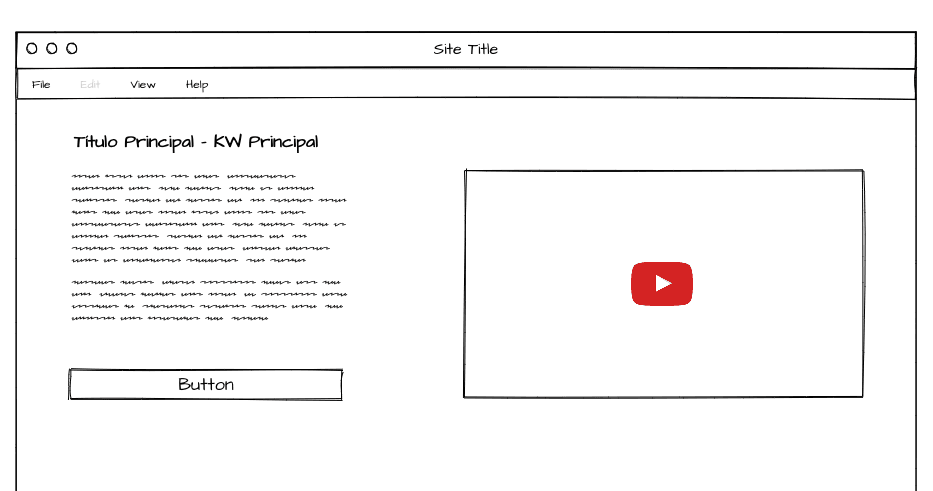
View of the above the fold in the mockup of an optimized landing page
In this landing example, we have used a resource such as video. It can be replaced by other graphic elements such as "image sliders or a single image".
Example 1.
- Main Title. For SEO purposes, this element will be our H1 and will contain the main term to be positioned. If we think it's appropriate, it's a good place to put a long tail.
- Text. A tricky part, because it has to be informative and contain aspects related to our USP or unique value proposition. Why choose us? What makes us different? What will the user find?
- CTA or button that calls for user action, whether to direct them to the contact page, request a quote, or send the user to another page.
- Video/image: Video is an interesting resource to increase time on our page and to improve the persuasive argument for the action (purchase, subscription, quote...). We can also opt for an image or a slider with different images of a product.
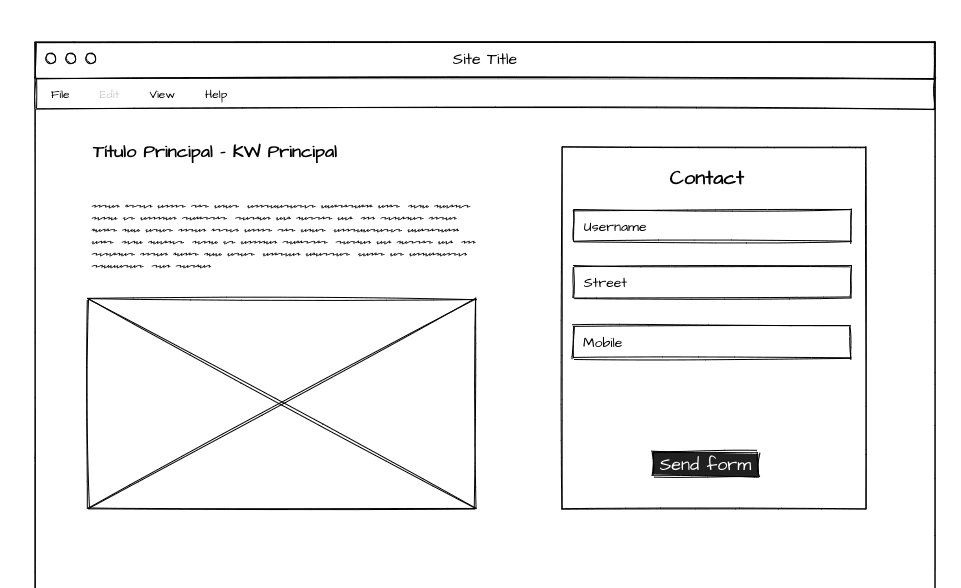
Example of an optimized landing page mockup
Example 2.
In this example the elements are the same but we have opted for a form instead of a contact button and for a text section with an image on the informative / persuasive side.
Tip #3: Content Structure
Yes, earlier we also talked about content, clearly, but it is at this point that we are going to structure our content based on the keyword research performed. If you are new to SEO and don't know what keyword research is, we recommend you take a look at the following article, where we explain in detail how to do it:
Recommended article: Complete keyword research guide At this point, it is essential to be clear about the conclusions needed to know how we are going to structure the rest of the web page. For this we have:
- Related terms with searches
- Long-tail terms with searches
- Questions the user asks about the product/service
- Questions we need to clarify for the user (NOT SEO)
Based on these 4 points we are going to build our landing page. When the answer is affirmative, the next step is to know whether we can position that term with a landing page whose focus is on a more specific term, or whether we need another page exclusively for that new term.
Let's take an example:
We have the main keyword, "psychology books" with 2,900 searches and some of its secondary terms are:
- social psychology books
- free psychology books
- children's psychology books
- psychology books for beginners
- recommended psychology books
In the Google "People also ask" box we find these:
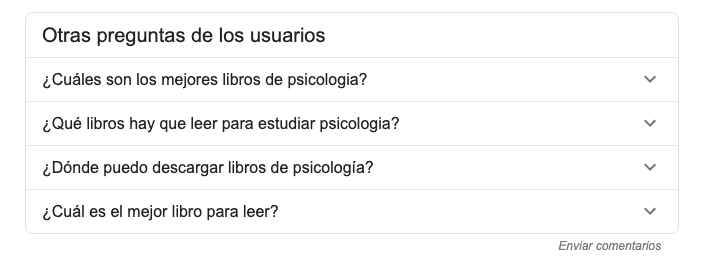
Frequently asked questions section in Google's SERPs
Based on this content, we are going to design our website texts. I insist again that it will be the SERPs that tell us whether or not we should add the content of related terms on this landing page.
Let's remember that this is the SEO content we're interested in, but there is a product or service that we need to explain or argue the value of. Let's not forget that we want the user to perform an action linked to our business; our work should not simply end with the visit.
Tip #4: Include Your Keywords on the Landing Page
Now that we have a broader view of the different terms we are interested in positioning, we are going to indicate where we should have the terms.
- TITLE tag: This is the most important tag within our HTML. We can see it in the search results and in the browser tab. We already know that characters are limited but try not to do the same as the competition.
- Meta Description: Although over the years this tag has lost weight in SEO positioning and, increasingly, Google chooses what content to display in the description space in the SERPs, don't stop filling in this field based on your content and with some call to action.
- Headers: Use the header hierarchy to highlight the important parts of your text. Using more H2s won't make you rank, but it will help Google better understand your content.
- Images: Images have several attributes that are interesting. Before uploading an image, take advantage of the filename to include important terms. In the ALT tag add a description of that image and you can even use the TITLE tag to intensify that description. Of course, don't overdo it by putting the same keyword in all the fields for all your images.
Tip #5: Link Modules & Breadcrumbs
Another tip for creating an optimized landing page is to group content with the goal of creating a content cluster. A content cluster is a part of the website whose theme is even more related to each other than the rest of the site. Through link modules and breadcrumbs, the intrinsic relationship of content is strengthened. So it doesn't remain too abstract, we'll present the following example:
Suppose we have a movie website and we are creating the landing page for the Oscars. In this landing we would create a link module to target other terms related to the Oscars: nominees, winners, actors with Oscars, actresses, directors... All that content grouped and linked together would form a thematic cluster of the Oscar Awards.
We are giving Google information through the links we have and about much more content related to the Oscars, so the relevance on the topic will be increased.
Tip #6: Structured Data
The type of data markup that Schema provides us and that has become a standard, provides more information to search engines about the type of content we are offering. There are certain contents such as products or services, in which it is essential to tag the different attributes, since on many occasions it will make us gain more visibility in the search results.
We recommend taking a look at the official schema.org page, to get more information about the creation of structured data.
Tip #7: FAQS
In line with the above, within structured data we have the FAQPAGE type within the WebPage property. This type of markup is used when we have questions and answers that offer help to the user regarding our product or service. For a few months now, Google has been showing a dropdown with some of these questions in the search results, which gains space in the SERPs and therefore visibility.
If the questions and answers are provided by users it is advisable to use the https://schema.org/QAPage markup
Here is an example:
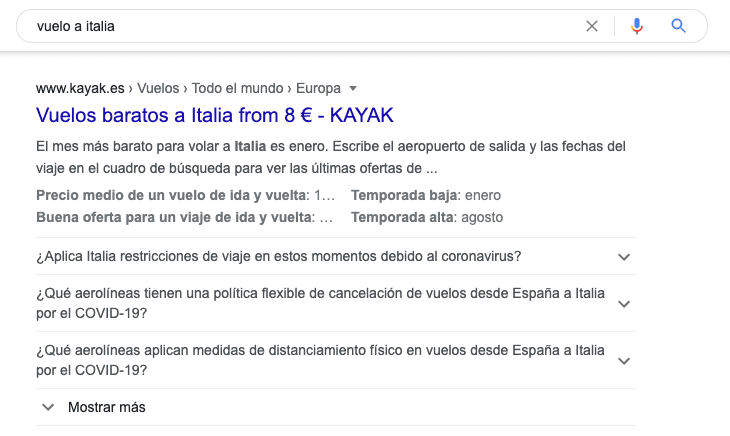
Example of a FAQ Snippet from the kayak.es website in Google's SERPs
Tip #8: WPO or Loading Speed
Finally, and as they say "but not least", since we have created an optimized landing page, we must not forget that the optimization of loading speed can give us the success or failure in achieving the "lead".
Why do we have to take it into account? Because if a user has chosen us and, upon entering, several seconds pass before the website loads, all the work we have done to be an option for this user will have been wasted simply by not having a page that loads quickly.
At SEOcrawl AI we have prepared a complete guide on WPO, which we recommend you take a look at, to learn how to improve this aspect in your new landing page.
Conclusions
The objective of this article has been to let you know how to create an SEO-optimized landing page. We wanted to offer you an outline of the most important parts so that you yourself can start creating your landing page. At SEOcrawl AI, we recommend that you take into account the tips we have provided, as this will help you convert your potential users into quality organic leads.
*What guidelines do you follow for the creation and optimization of a landing page for SEO? *
You can leave us a comment if you wish, we will be happy to respond. Until next time!
Author: David Kaufmann

I've spent the last 10+ years completely obsessed with SEO — and honestly, I wouldn't have it any other way.
My career hit a new level when I worked as a senior SEO specialist for Chess.com — one of the top 100 most visited websites on the entire internet. Operating at that scale, across millions of pages, dozens of languages, and one of the most competitive SERPs out there, taught me things no course or certification ever could. That experience changed my perspective on what great SEO really looks like — and it became the foundation for everything I've built since.
From that experience, I founded SEO Alive — an agency for brands that are serious about organic growth. We're not here to sell dashboards and monthly reports. We're here to build strategies that actually move the needle, combining the best of classical SEO with the exciting new world of Generative Engine Optimization (GEO) — making sure your brand shows up not just in Google's blue links, but inside the AI-generated answers that ChatGPT, Perplexity, and Google AI Overviews are delivering to millions of people every single day.
And because I couldn't find a tool that handled both of those worlds properly, I built one myself — SEOcrawl AI, an enterprise SEO intelligence platform that brings together rankings, technical audits, backlink monitoring, crawl health, and AI brand visibility tracking all in one place. It's the platform I always wished existed.
Discover more content about this author