The 7 Most Important Meta Tags in SEO
When we talk about SEO, we inevitably refer to the use of tags and the importance they have. While they are part of the daily routine for an experienced SEO consultant, for many others they can cause confusion, and above all, misusing them can lead to serious problems in their projects.
Below, we will list and detail the most important SEO meta tags, how to use them, and especially the mistakes we should avoid.
What are meta tags?
Meta tags are key code fragments that appear in the HTML code of a website and help search engines better interpret the page by providing them with extra information about it.
The correct use of meta tags has significant weight in SEO, since it provides a key element to Google and can make the difference between a well-positioned website and one with poor visibility.
The Most Important Meta Tags
Meta title
The title tag is responsible for telling search engines the main idea or topic that the content of the page they are going to crawl is about.
It is recommended not to exceed 70 characters, as otherwise they will appear cut off in SERP results, standing out less compared to the rest. It is essential to use the keyword we want to rank for in this tag, in a clear, concise and eye-catching way for users. We must place it within the <head>.
Let's look at a simple example:
<**title**>SEO Crawler & Generative Engine Optimization (GEO) Software</**title**>
It is often the great forgotten one. A very common mistake is to think that because it is such a "basic" tag it lacks SEO weight. Nothing could be further from the truth, since as we can see it will be "our calling card" to Google.
Meta Description
Complementing the Title tag, with the meta description we will provide somewhat more extensive information to search engines about the content of our page. We will try to detail as precisely as possible the content we are going to offer to the user.
It is recommended not to exceed 155 characters, as in the previous case, to avoid appearing cut off and losing visibility compared to the rest. Since we have more length available, we will take advantage of it to use semantic keywords and related terms, helping Google to understand us and therefore categorize us better.
It is important not to forget that we write for users, logically without losing sight of Google, but we have to try to create meta descriptions that attract and convince users to view our content.
<meta name="**description**" content="SEO crawler and Generative Engine Optimization software: crawl your site, track rankings and grow your brand's visibility in ChatGPT, Gemini and Perplexity.">
Let's see how we will appear in search results with this tagging implemented:

H tags: Heading hierarchy
As the name suggests, headings will serve to hierarchize and order the content of a page, in order of importance (h1, h2, h3…).
Just as happens in a regular book, thanks to headings we will highlight paragraphs and more relevant content over other more secondary ones. It is therefore recommended, when using them, to use text paragraphs on which to place them.
A single h1 is used, which will be the one that defines the title of the content. Be careful not to confuse the title of the content determined by this tag with the meta title tag seen previously. While the meta title is used for our visibility in the SERPs, the h1 tag will be visible to the user while they are reading our content.
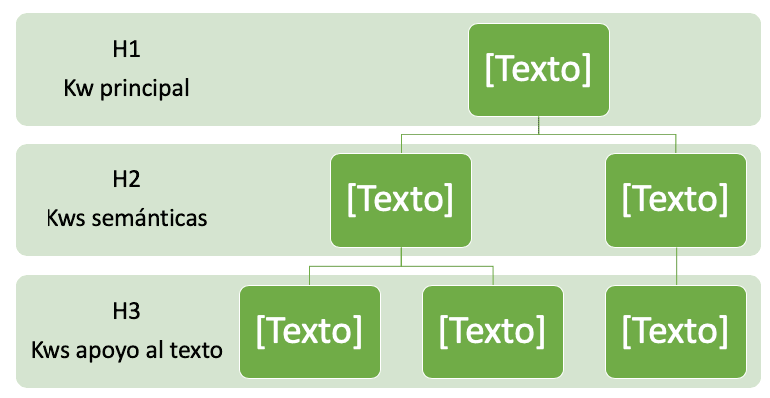
Example of heading structure on a website
Therefore, they are not only useful for Google to categorize our website, but also to facilitate reading by users.
A very common mistake is to use several h1 tags on the same page, many of them without SEO value such as "leave a comment here", "subscribe to our newsletter", etc.,
We will again use the main keyword in the h1. We will take advantage of the rest, h2, h3, etc., to support through subsections with semantic keywords, related terms, synonyms, questions, etc.,
Normally we do not go much beyond h3 or perhaps h4, it will depend on the design we have, but at the SEO level, attention is usually paid to optimization mainly in h1, h2 and h3, using the rest to have an optimal user experience.
As an example let's see how they are represented:
In an example from one of our articles:
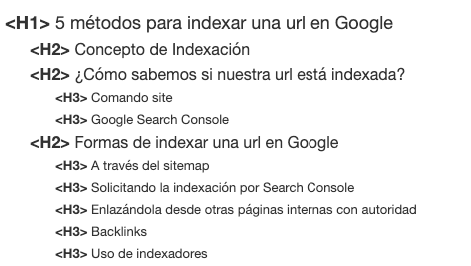
Table of contents with the structure of the headings.
Canonical tag
The canonical meta tag is used to tell Google which is the original page in case we encounter similar or identical pages.
<link rel="canonical" href="/" />
We will call the original URL the canonical URL, and the URL that can be considered as a copy we will say is the canonicalized URL. And both will be related by the canonical tag.
This tag has great importance like the previous ones, since incorrect use of it can lead Google to think that the important page is the incorrect one. Because this tag needs more complete development, we recommend reading our guide to using the canonical tag, which will help you understand it in depth.
ALT tag
When it comes to ranking in Google, we should not forget ranking in Google images. For this, we will use the ALT tag (alternative text), which will help Google to know what our image is about.
It therefore has the important mission of describing the content of an image to search engines. Likewise, if an image does not load for some reason, this text will appear, or if a screen reader is used to read aloud.
<img src="example-image.jpg" alt="**THIS IS THE ALT TEXT**" />
As we said, it not only has weight in terms of ranking in Google images, but it will also help us to once again employ important keywords that give more weight to our content in that specific search.
We recommend reading our content about SEO for images, where we talk in more depth about said tag.
Robots meta tag
Through this tag, we will indicate to Google what content should be indexed and what should not, as well as whether the links should be followed or not.
Let's explain this in more detail. We have the following parameters:
Index (taken by default)
Follow (taken by default)
Noindex (must be specified when we don't want a page to be indexed)
Nofollow (must be specified when we don't want the links on a page to be followed) The most common combinations we will find will be:
<meta name="**robots**" content="**noindex**, **nofollow**"> – Do not index this page and do not follow its links.
<meta name="**robots**" content="**index**, **follow**"> – Index and follow the links on this page.
This tag must be included in the <head> of our website.
Important: we can use the nofollow tag at page level or at individual link level. That is, if the entire page has a nofollow, it will not follow any of the links it contains, if on the contrary it does not have this tag, and it is only on one link on the page, that will be the only one it does not follow. It prevails more at page level than at link level.
Open Graph
Open Graph tags are a protocol that allows us to indicate to social networks what information to display each time a link from our website is shared.
Although they do not have a direct relationship with SEO, they are important at the user level and at the brand level, so it is recommended to pay attention to them since they will be our image on social networks.
They are implemented as follows:
<meta property="og:type" content="website" />
<meta property="og:title" content="title of your page or your post" />
<meta property="og:description" content="description of the page content" />
<meta property="og:image" content="link to the image file" />
<meta property="og:url" content="permalink" />
Chrome extensions to view meta tags
To help us analyze these meta tags, there are countless Chrome extensions that make our lives easier. We recommend you read our post on the best SEO extensions for Chrome to make the task easier.
And that's it for the list of the main SEO meta tags that we must keep in mind in any web positioning strategy, not only to avoid messing up and making a serious mistake, but to get as much potential as possible out of them.
Would you like to contribute something? We would love to read you in the comments section!
Author: David Kaufmann

I've spent the last 10+ years completely obsessed with SEO — and honestly, I wouldn't have it any other way.
My career hit a new level when I worked as a senior SEO specialist for Chess.com — one of the top 100 most visited websites on the entire internet. Operating at that scale, across millions of pages, dozens of languages, and one of the most competitive SERPs out there, taught me things no course or certification ever could. That experience changed my perspective on what great SEO really looks like — and it became the foundation for everything I've built since.
From that experience, I founded SEO Alive — an agency for brands that are serious about organic growth. We're not here to sell dashboards and monthly reports. We're here to build strategies that actually move the needle, combining the best of classical SEO with the exciting new world of Generative Engine Optimization (GEO) — making sure your brand shows up not just in Google's blue links, but inside the AI-generated answers that ChatGPT, Perplexity, and Google AI Overviews are delivering to millions of people every single day.
And because I couldn't find a tool that handled both of those worlds properly, I built one myself — SEOcrawl AI, an enterprise SEO intelligence platform that brings together rankings, technical audits, backlink monitoring, crawl health, and AI brand visibility tracking all in one place. It's the platform I always wished existed.
Discover more content about this author