How to Rank on Google
How do you rank on Google? Probably the most common question for anyone thinking about getting to the top of the search results. Do you have a website? Have you opened an online store and can't seem to get traffic or sales? If you're tired of watching others take the top spots in the SERPs, let's take a moment to reflect.
Below, we're going to explain how to rank on Google and stop being invisible.
The short answer, step by step, would be:
Learn
Study the project, the business, the competition, the sector…
Improve
Build
Promote
Evaluate
Any web project, whether you want to rank on Google or on any other search engine, has to be visible if you want to achieve profitability between revenue and expenses. There's no single path to get there, and not every project has the same characteristics, challenges, and opportunities.
That said, what you do need to be clear about is that SEO is a factor that creates assets in your business when it's done properly, and it's not at odds with paid-click strategies like Google Ads or Facebook Ads. Both should work together, as a team, coordinated, to get the most out of the project.
Here we're going to analyse how to rank on Google from an SEO perspective, which in my view is the most important of them all.
SEO evolves very quickly
Those of us who have spent years investigating and challenging search engine algorithms have witnessed the huge shift SEO has gone through: where Google used to make 500 changes a year, that number has since multiplied several times over.
Part of the appeal of SEO is that it's not an exact science or a single dogma — instead, it evolves constantly and we have to adapt. As artificial intelligence advances, we get results that are more aligned with its interests and those of users, or at least so they say.
Many techniques and strategies that worked years ago have had to evolve, and in some cases we've had to stop using them entirely to get results. Keyword stuffing, for example, is no longer recommended the way we used to do it: SEO moves fast and keeping up isn't always easy without the knowledge and a well-honed, scalable working method.
From the rudimentary early days of indexing — which based its answers on pages that matched the exact keyword — to today's complexity, built on artificial intelligence… it's a whole new world. Now concepts like user search intent are very much in vogue, but they've been used intuitively for years, for example by knowing the type of keyword you want to rank.
That's what makes SEO so exciting: it's a living process, one that demands constant updating from the professional, challenges them every day, and requires maximum intelligence to "beat" in this particular chess match.

And although people have been saying for years that SEO is dead, the one thing that hasn't changed is the fundamental role search engine positioning plays in online businesses — it remains a clear differentiating milestone for making a web project profitable. If you run a business, you can't and shouldn't overlook it.
Want to know how an SEO consultant approaches each ranking project?
We know a method is working when it delivers results on our projects and on those of our clients (national and international companies) and holds up under constant audits aimed at improvement.
SEO onboarding — initial briefing
Before you start working on the SEO of a site or an online store, you need to carry out a preliminary study of the client's business, their products and services, their weaknesses and strengths, etc. Without a complete and detailed initial briefing aimed at understanding the project, we'll make the wrong calls on strategic decisions, resources, and other issues tied to the project's profitability.
At the same time, it's vital to correctly identify competitors, their evolution and history, their SEO strategy and the execution they've been delivering over time to get where they are. After all, if they're already ranking and we're not, we'll absolutely need to improve on what they have and "steal" that traffic and that hard-earned visibility.
Whether you hire an SEO agency or a freelance SEO, the first thing they should do is get to know the project, its goals, its objectives, its resources, its differentiating value, and the company's actual capacity to see it through.
For example, if the project lacks trained, suitable staff, we'll need to consider offering that extra full-execution service. If, on the other hand, they have an internal team, the challenge is properly aligning with each resource.
What does the initial SEO briefing look like for ranking on Google?
1. Starting situation
Without a basic analysis of what the project's starting situation is (both the website and the business itself within its segment), any SEO project gets off to a bad start.
Although an analysis is often requested or offered at the outset or during contact with the people in charge of certain areas, such as web architecture or the wins and losses in technical SEO, this is building the roof before the foundation. Both are obviously highly relevant aspects, but not at this point.
You can set up a highly worked target keyword strategy that, in reality, doesn't serve the project's goals 100% (mainly, billing more), even if it does show you've moved up in the SERPs.
So we need to establish an initial SEO briefing in which the project or its lead clearly defines:
2. Project needs
The first thing to do is ask the client what they need. We sometimes forget that our main job is to help our clients satisfy and cover what they really need, at the moment they need it.
3. Who they are
It's essential to get to know the company from the inside — who they are, why they are where they are, who is part of the team we'll be working with, what roles each person plays, their value proposition, their competitive advantages, and the differentiating value through which they win or aim to win their market share.
Running a basic SWOT at this stage is very useful so that the company and the SEO team get on the same page before getting down to work, knowing the project's weaknesses, threats, strengths, and opportunities.
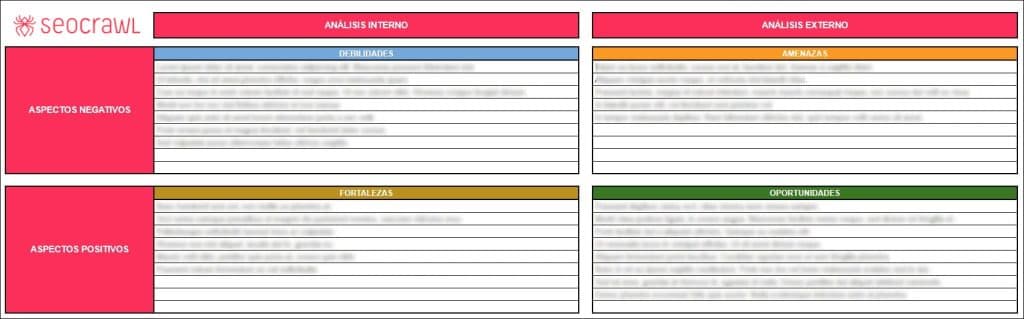
No two businesses are the same, not even if they do exactly the same thing, and laying out this information at the outset helps the SEO consultant make decisions and plan a strategy tailored to the company. The alternative is a race against time. And in SEO, time is visits and sales running against you. Money down the drain.
4. Resources the project has
A key aspect, yet one very few SEOs and managers stop to think about at the start of a project to rank on Google, has to do with the resources the organisation has available to carry out everything the SEO consultancy proposes.
Does it have a communications department, or will it need an external service? Does it have developers and designers to execute possible improvements and opportunity tests that may come up? Does it bring existing content, or does everything need to be generated from scratch? Do they have copywriters? What about UX specialists?
5. Their history
On top of all this information, you mustn't forget to do a prior audit of the history of investment and work in SEO. Why? Maybe you'll find that the website has received a Google penalty for past bad practices, which would drag on short and medium-term results.
Small tip: knowing the documentation a client is used to working with will particularly help you align with them.
Likewise, this SEO retrospective gives us a very clear picture of the point at which the project went off the rails. There are cases where the foundations are properly in place, but for some reason the goal gets lost (there's no SEO consultant behind it, resources are lacking, or there's a lack of continuity on the project, among other common causes).
SEO competition
Analysing your competition — that is, those who are right now where you want to get to — is crucial when designing and executing a ranking strategy.
How do I know who my competition is on Google?
This is one of the big questions managers and business owners don't always know how to answer when we first engage with their web project.
Not every company lead can tell apart direct competitors (similar prices, same sector and target audience) from aspirational competitors (the long-term objective, or companies to use as a benchmark). The latter don't always need to be in the same business category, but the former do.
Even when we tend to focus on the companies we've always identified as our natural competitors, on the internet the ecosystem may be different. A simple investigation can reveal projects whose existence you weren't aware of, or even force you to compete with giants like Amazon.
What should we analyse about the SEO competition?
You have to know what they do, how they do it, and whether there are errors in their project you can use to improve the experience in your own business and create an opportunity to stand out against them. Sounds easy, right?
Using tools like SEMrush, Sistrix or Ahrefs lets us identify competitors who may overtake us in the SERPs or who sit just above us — and therefore the first ones we need to checkmate if we want to compete in the top league.
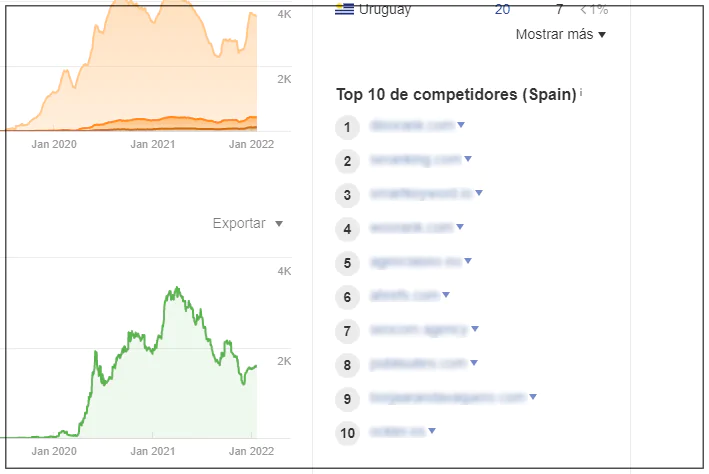
What are my competitors doing?
Once we have a list of potential competitors, it's time to roll up our sleeves and dive into their strategy. Which keywords do they rank for? Which are their top-traffic URLs? Are their SEO goals and results aligned?
Another factor to review in detail is their traffic channels and the volume each one contributes. Is it all organic? What share corresponds to paid traffic and on which platforms? SEO tools like SEMrush or Sistrix give you this information in great detail in their paid versions.
In those tools, you simply enter the URL and the technology analyses many of the SEO factors that determine how to rank on Google and which of them are reflected in those URLs. Of course, the deep analytical part belongs to the SEO consultant.
How do they do it?
You already know what they do, but not how. Here, in addition to experience, SEO tools are decisive — and most importantly, running a motivated analysis with at least some historical depth. Only then will you get a real view of the SEO work your competitors are doing.
For example, with SEMrush you can track what kinds of ads and copy they use, as well as estimated spend (important: all data is estimated), what links they earn, how often, from which domains (and IPs, which may also play a role in ranking), which content brings in the most traffic (and from there analyse what's "good" about it to inform our own content strategy), whether they work on social-media authority or use them as URL aggregators, and so on.
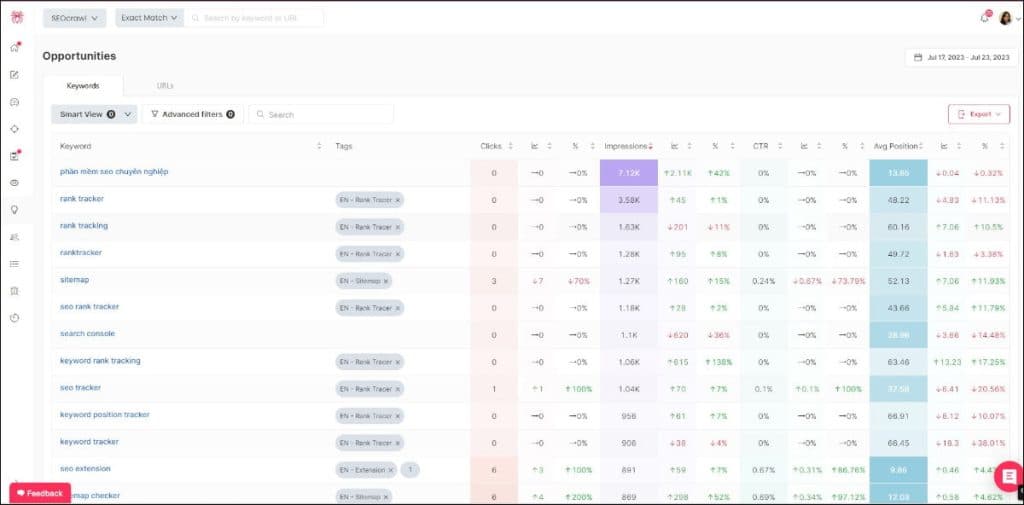
SEOcrawl AI, for example, gives you a very clear view of the on-page SEO opportunities for your project in more detail than any other tool, since it works with data from your Google Search Console account. That way, you can build a visual comparison of which keywords your competition isn't working — an avenue to cover a "virgin" or low-competition segment, for example.
To go deeper into the link area, it's important to keep a close eye on the semantic affinity and quality of the site that links to us. For that, the most complete tool so far is LinkAffinity.
Is it worth using a single tool? Yes and no. Using multiple information sources gives you unique data. All that data, properly processed, yields very interesting information and unique knowledge.
We SEO consultants generally work with several tools, depending on the needs and the project, where we cross-check results between them to draw the most realistic picture possible of how to approach the project to rank on Google and how to execute it.
On the other hand, we shouldn't obsess over having lots of tools for every project. It's important to know how to use each one and squeeze the most out of them.
People often fall into "tool-itis" just to produce lists of things, rather than tapping into the huge potential today's tools like Sistrix, Semrush or SEOcrawl AI actually have.
Why do we think our competition is where it is?
This is where not only analytical capacity comes into play, but also the knowledge of SEO strategies that comes from real experience in the search engines' arena. With both, we can define the points where results and actions connect (yes, in reverse).
From there, we can infer what may be working for them and get a sense of why.
Important nuance: copying the competition's strategy doesn't mean we'll get the same results. Go back to the opening section, where we explained why it's important to analyse the competition — not just for their online visibility, but above all from a business standpoint.
We can even estimate a monthly investment budget range for each competitor, multiply it by the months they've been active (and even how long they've been in organic-growth phases) and, in this way, estimate a "total SEO investment" to reach their current visibility.
This last point is very interesting. Many clients ask how long it will take them to rank. The standard answer is "SEO is a long-term game." But that's said more as a set phrase than with any analytical sense. SEO is not a long-term game.
-
In SEO you build, almost always, from the second month of work.
-
In SEO you should notice a visibility lift from the moment things start getting created and actions are being executed.
-
In SEO you prioritise what can generate the biggest impact.
-
In SEO we're not going to win competitive, relevant keywords from day one — we need to earn the trust of users and search engines, demonstrate what we know and what we can offer.
-
In SEO… we must not underestimate the past, current, and future work of our competition.
Setting objectives
Now we reach the tricky part of any Google ranking project: setting SEO objectives, tactics, and the work plan. All of them share one quality: they must be realistic and in line with the project's possibilities in terms of resources and starting point.

In this way, we'll cover stages with a return on profitability and avoid frustration both for the business owner and for the SEO consultant.
Without a clear objective, there's no way to lay out a strategy for how to rank on Google.
The usual approach is to work with so-called SMART objectives (Specific, Measurable, Attainable, Relevant and Timely).
-
Specific. Every project pursues certain results. Depending on them (leads, direct sales, branding), you'll set a different strategy and different actions. The more specific the SEO objectives, the easier it will be to visualise the path and the pitfalls.
-
Measurable. As an SEO consultant, you must be able to show the business lead the evolution in rankings and results.
-
Attainable. Depending on the nature of the project, the competition, the history, and the available resources.
-
Relevant. Do they really help achieve the client's main goal, regardless of whether it's via leads, direct sales, or brand image?
-
Timely. Set dates to evaluate the performance of each action and to review which objectives have been met and which haven't.
Leads: common objectives
Here we're looking to generate clients who in turn become a source of revenue, whether in the short or long term. The key indicator is going to be the conversion rate that SEO contributes and all the factors involved (copy, user experience, relevance, added value...).
We can even create funnels where we accompany and guide the user toward where we really want them to go.
Which KPIs can we measure quickly on these projects?
-
Calls
-
Submitted forms
-
Cost per lead
-
Chats
-
WhatsApp
-
Views of a specific piece of strategic content
-
Downloads of a specific strategic resource
-
Organic traffic
-
Conversion rate per objective
Example 1: A services directory
There are plenty of "best lawyers, dentists, gynaecologists…" guide-style pages. Despite high competition, a proper lead-focused SEO strategy brings in qualified traffic to serve that information to those listed in the portal.
From there, we'll think about the appropriate strategy based on the business objectives: national, international, provincial, local...
Example 2: Insurance sector
This segment is now waking up to SEO after a long dependence on SEM and paid traffic from the big brands. In fact, they're increasingly encouraging their agents to set up online projects to get more presence and potential clients.
How do we optimise resources? By reducing the advertising balance and offering an SEO strategy focused on the user through the generation of high-quality original content.
E-commerce
When it's an e-commerce site, the focus changes. It's not just about attracting users, but about convincing them that we offer the solution to their problems — that is, the pursuit of the "immediate" sale.
The objective here will be to attract visits with purchase intent and every SEO strategy will be aimed in that direction.
Which KPIs can we measure quickly on these projects?
-
Calls
-
Transactions (sales)
-
Revenue
-
Average order value
-
Abandoned carts
-
Chats
-
WhatsApp interactions
-
Views of a specific piece of strategic content
-
Downloads of a specific strategic resource
-
Organic traffic
-
Pages per session
-
Average session duration
Example 1: Consumer-electronics e-commerce
In this case, it's obvious that one of the biggest competitors is Amazon. Its potential may be discouraging, but even so there are plenty of options for your site to find profitability.
You can draw inspiration from PcComponentes or La Casa del Electrodoméstico. It all comes down to knowing how to spot opportunities and make the most of them.
Example 2: From a traditional local business to selling online across the country
On the internet, not everything depends on the size of your project. You can have a neighbourhood store and become a national reference if you work on the web architecture of your online store, you carefully craft the content of key categories and products, and you set up a good link-building strategy. The branding part is in your DNA. We help it become visible.
Branding
When you're pursuing the goal of building brand and reputation, the SEO focus moves toward long-term conversion, with small trust milestones you have to hit on the way to your big goal (selling a service, a company, or a startup).
Which KPIs can we measure quickly on these projects?
-
Mentions to the home
-
Mentions by page type
-
Referring domains
-
Backlinks
-
Brand-keyword rankings
-
Brand vs. non-brand traffic
-
Engagement (comments, subscribers, etc.)
Example 1: a globally known brand seeking international presence
In many projects, international organic presence is zero. For this type of company, it's essential to start from a good brand presence, which later eases the organic work and the strategy.
Example 2: a real-estate agent's personal brand
Maybe one of the toughest sectors to stand out in — and at the same time, one in which personal branding is most effective. Here, the agent's capacity for empathy and the potential seller or buyer's receptiveness come into play.
SEO will build the personal brand as a specialist in a specific segment (rentals, property sourcing, seller, etc.), and if they have a company brand backing them up, they'll be able to use it to their advantage.
Other objectives
Although these are the most common projects, SEO adds value to an infinite range of projects and economic and social activities.
Example 1: Affiliate projects
Amazon isn't the only game in town. Other platforms also offer percentages on sales via referrals. In this case, you need to look for a mix of technical SEO, content SEO, and persuasive copy.
Example 2: NGOs and public institutions
Two actors completely different from the rest of the cases, and indeed from each other. They do share one common goal: to build an institutional image that lets them generate public trust. The former to secure contributions; the latter, votes.
The SEO strategy here will be long-term, heavily dependent on landing pages at the NGO and a greater interplay between link building and SEM with SEO itself, while the latter will be dominant for public institutions.
Conclusion
In short, with all the initial information about the company, the project, its history, its needs, its current state, its problems, etc., we have the capacity to lay out the strategy that solves the main problem: how to rank on Google.
If you have any questions or want to share any thoughts with us about how to rank your project on Google, we'll be waiting for you in the comments section. :)
Author: David Kaufmann

I've spent the last 10+ years completely obsessed with SEO — and honestly, I wouldn't have it any other way.
My career hit a new level when I worked as a senior SEO specialist for Chess.com — one of the top 100 most visited websites on the entire internet. Operating at that scale, across millions of pages, dozens of languages, and one of the most competitive SERPs out there, taught me things no course or certification ever could. That experience changed my perspective on what great SEO really looks like — and it became the foundation for everything I've built since.
From that experience, I founded SEO Alive — an agency for brands that are serious about organic growth. We're not here to sell dashboards and monthly reports. We're here to build strategies that actually move the needle, combining the best of classical SEO with the exciting new world of Generative Engine Optimization (GEO) — making sure your brand shows up not just in Google's blue links, but inside the AI-generated answers that ChatGPT, Perplexity, and Google AI Overviews are delivering to millions of people every single day.
And because I couldn't find a tool that handled both of those worlds properly, I built one myself — SEOcrawl AI, an enterprise SEO intelligence platform that brings together rankings, technical audits, backlink monitoring, crawl health, and AI brand visibility tracking all in one place. It's the platform I always wished existed.
Discover more content about this author
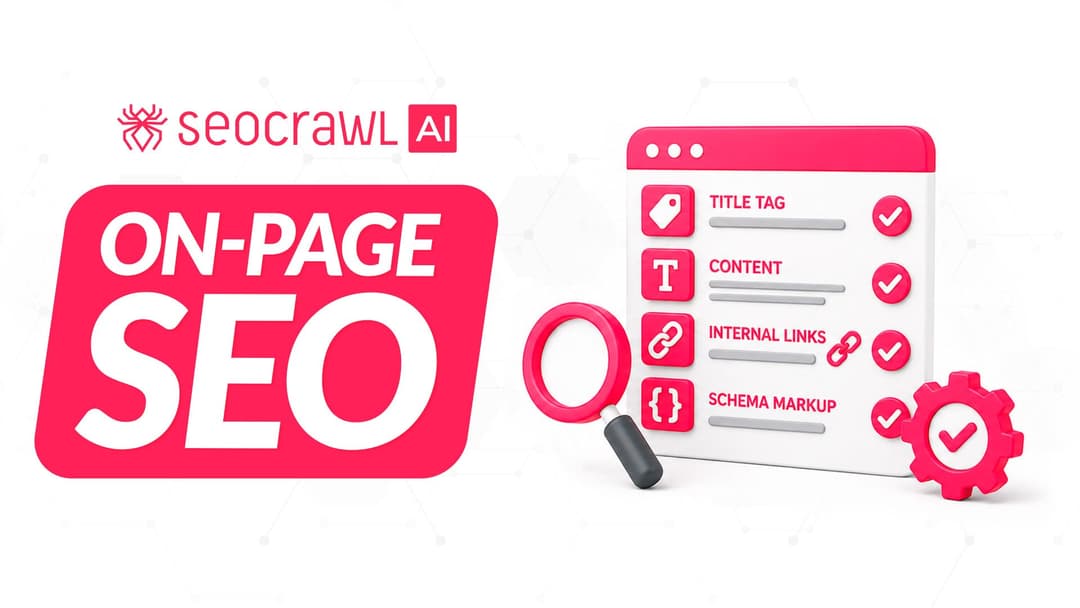
On-page SEO is everything you control on a page: content, title, meta description, headings, URL, images and internal links. Here is a checklist element by element, an audit process and what changes with AI Overviews and AI Mode.