Hotel SEO
Do you have a hotel business in the tourism sector and don't know how to increase your visits to get more bookings from clients? Then you probably haven't developed an SEO strategy for hotels, or the one you have isn't working as it should. Don't worry! In this article, we'll show you step by step how to plan, develop, and implement an effective and 100% profitable hotel SEO strategy for your business. Will you join us? ?
Elements of an SEO strategy for hotels
When defining the key elements for developing an SEO strategy for hotels, we need to stop and think for a moment. Are we clear about who our target is? In which destination do we want to rank? Do we have a hotel in a specific location, or are we a national hotel chain? Who are our competitors? These are some of the questions we will address throughout this article, and they will undoubtedly help us implement our hotel SEO strategy.
Defining our target audience: The buyer persona
Knowing the profile of our ideal client is essential in any web positioning strategy, and hotel SEO is no exception. The audience segment looking for a 5-star hotel in the center of Marbella is not the same as the one looking for a vacation home on the Costa del Sol; moreover, their interests and needs are different.
The ultimate goal of defining the buyer persona is to gather as much information as possible to get a clear idea of who our potential client is and thus improve future actions in our SEO strategy. Therefore, to gather as much information as possible for the actions to be carried out, let's create a short checklist with the key elements to find and define our target in a hotel SEO strategy. Let's go! ?
How to find information about our ideal buyer persona for our hotel business?
- Conduct a study of clients in your hotel's database or CRM. With this action, you can identify a user profile pattern based on their consumption habits, visit frequency, spending, etc.
- Use web analytics tools to find out where your customers' visits come from. This online action can help you know where traffic is coming from. Do your users find you through social media? Are they new or returning users? Are they organic visits or direct traffic? Good tracking of all traffic will help you deeply understand your business's online channel.
- Create more complete forms on your website to collect relevant information. The more knowledge we have of our potential client, the better we can define search intents and content for users.
- Create personalized satisfaction surveys for your clients. This action, besides being an element of loyalty and engagement, will help you learn more about their tastes, preferences, and areas for improvement.
Since each person has different tastes, preferences, and needs, it's important to establish a series of questions tailored to the hotel sector to define our buyer persona.
At SEOcrawl AI, we suggest you include the following:
- What is their name and what do they look like?
- Age, gender, educational level?
- What is their professional profile?
- Why are they interested in booking a service at our hotel?
- What do they value most about our service? Price? Location? Quality?
- What has their experience been at other hotels?
- What problems or inconveniences do they face when making a hotel reservation?
Once we have all the information gathered, we will be able to analyze the "pain points" that can help us offer better service solutions at our hotel.
Done! ? With all this, we will have identified our *buyer persona. *The next point we'll study is competitor analysis for our hotel SEO strategy.
Analyzing organic competitors
Here we should ask ourselves... What other websites are ranking for search terms similar to those we offer with our services? If the websites already ranking on Google have a higher level of optimization and popularity than ours, then it will be harder to compete with them, and we'll need to take that into account when prioritizing target terms in the short, medium, and long term.
If we analyze from a business and site content standpoint, there are other factors we need to consider when analyzing competitors in a hotel SEO strategy:
Differentiation by price in services: Does our hotel business stand out for having lower prices than the competition? Do we have offers available? If so, in a keyword strategy, you can target long tail searches such as:
- "cheap hotels in + location"
- "budget hotels in + location"
- "hotel deals in + location"
Differentiation by profit margin in services: Do we have services that yield a higher profit margin than others? If that's our case, we can boost the rankings of those that generate greater profit for our business:
- "hotels in + location + with spa"
- "hotels in + location + with jacuzzi"
Initial ranking of existing content for target business keywords: What is the initial ranking of our hotel website? Are we already ranking for any keyword? If so, we can prioritize the positioning of relevant terms and create content to target users' search intents. For example, by creating a travel blog where we develop content recounting experiences from the destinations where we offer our services.
Analyzing competitors in Google SERPs
Let's say we have a hotel in Asturias and we want to appear in search engines like Google. The hotel niche is extremely competitive, so it will be very difficult (not to say almost impossible) to rank for generic and highly specific keywords like "hotels in Asturias," as the top positions are dominated by large accommodation booking websites like Booking, TripAdvisor, or Atrápalo... Let's see an example. If we do a Google search for the term "hotels in Asturias":
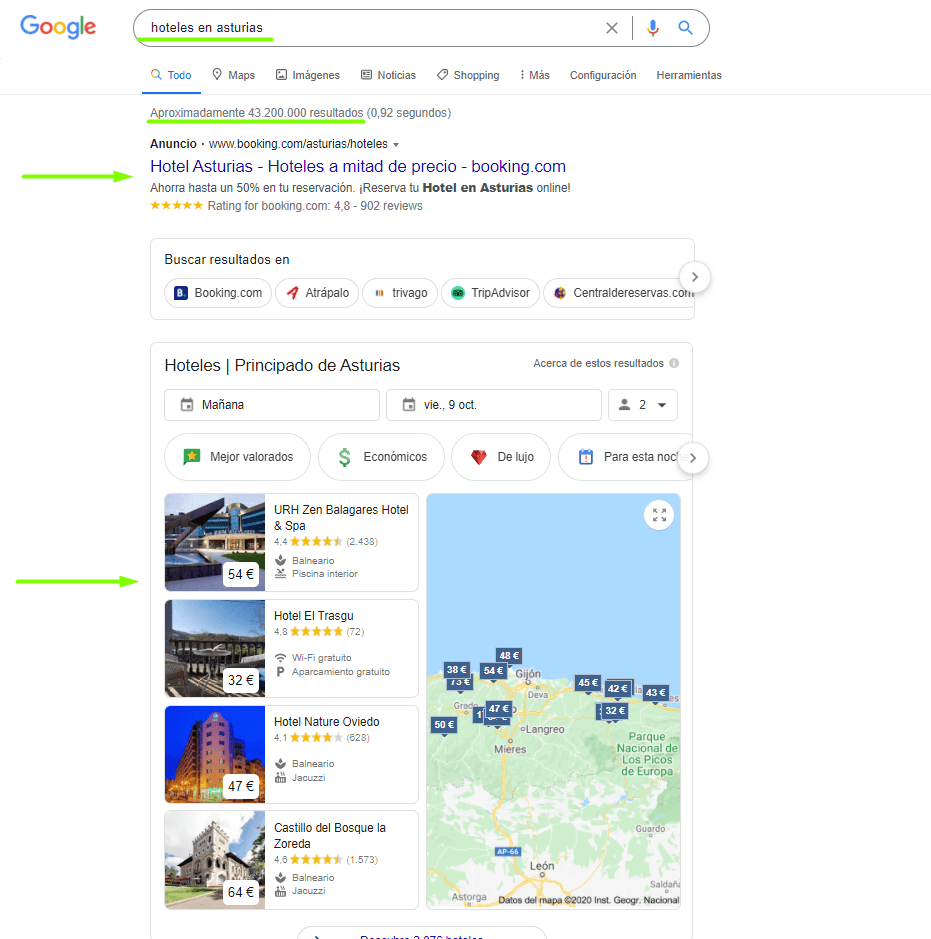
Example of how Google displays results in the SERPs for the search term "hotels in Asturias"
The search engine returns approximately 43,200,000 results. For this search, Google modifies the "SERP features" and shows the content it considers most optimal for users' search intents. Let's see it in detail! ?
-
The first thing we find is a PPC ad from Booking with an optimized rich snippet of review ratings.
-
Secondly, Google shows us a giant Snack Pack where:
-
We have the option to choose whether we want to search for results on Booking, Atrápalo, Trivago, TripAdvisor...
-
We can filter the search by date range to make a reservation on the spot.
-
We can choose from a carousel of options classified by "rating," "price," "luxury," "book today"...
-
Google displays the 4 hotels to which it grants the most relevance and visibility for the search "hotels in asturias."
-
We can see the map with the prices of the hotel results shown on the left side, and others that Google considers relevant and therefore also displays.
- The Top 3 organic results are dominated by these large travel websites (search engines/online comparison sites):
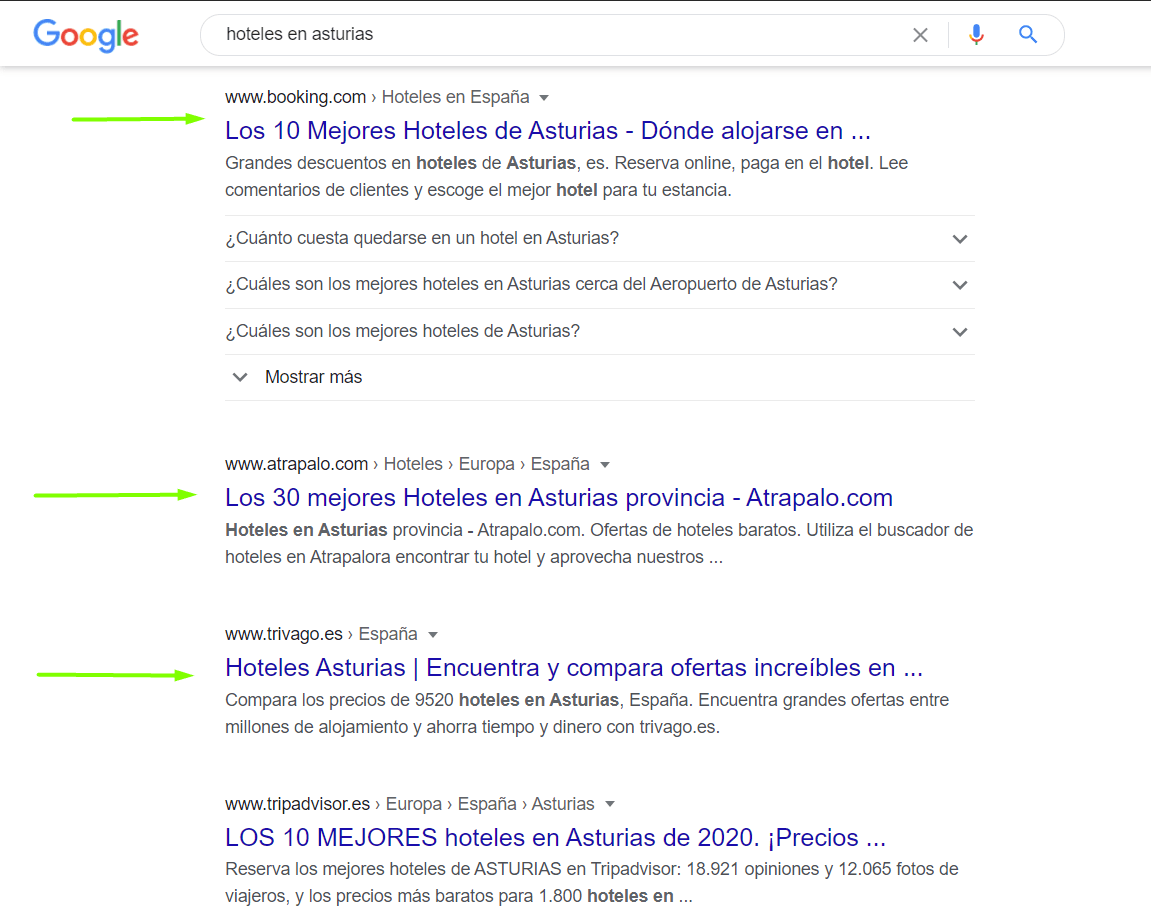
Top 3 organic results for the search "hotels in Asturias"
As we can see, the results pages are changing by leaps and bounds. Google's algorithm is increasingly optimized, and organic results are pushed down by multiple functionalities in the SERPs (rich snippets, sitelinks, featured videos and images, carousels, local packs, shopping ads...). For this reason, and also due to the increasingly fierce competition, it is necessary to implement a hotel SEO strategy with a very well-developed keyword research that allows us to capture as many quality visits as possible, and that ultimately achieves the final goal: securing a reservation on our hotel website.
Analyzing competitors with SEO tools
There are numerous SEO tools on the market with which we can study our organic competitors and analyze what type of strategies they are carrying out. One of these tools is Ahrefs, and with it, we can draw many conclusions about our competition. Let's take a look! ?
If we continue with our example of the hotel in Asturias, and through the keyword explorer functionality we do a search for this term ("hotels in Asturias"):
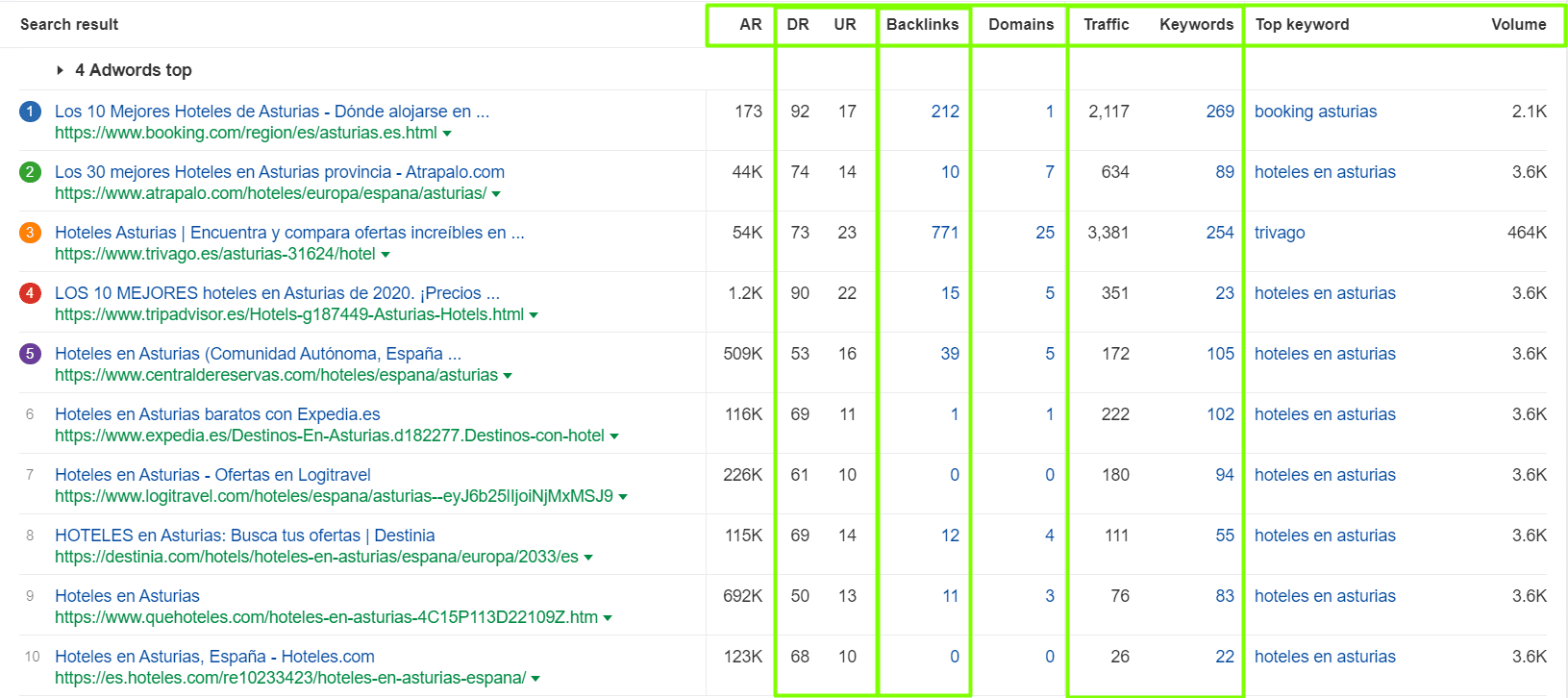
Analysis of the Top 10 organic competitors for the search term "hotels in Asturias"
We'll be able to see as a whole the different metrics that Ahrefs provides for competitor analysis:
- AR (Ahrefs Rank): Shows the "strength" in terms of backlink profile of a website relative to Ahrefs' database.
- DR and UR: The Domain Rating (DR) is a granular version of the AR, based on a logarithmic scale of 0-100 points where 100 is the highest ranking. The UR metric is the same as DR but applied at the URL level.
- Backlinks: Refers to the total number of links from other websites pointing to this search result.
- Domains: The total number of unique domains linking to the analyzed website.
- Traffic: Shows an estimated monthly organic traffic to the website.
- Keywords: Shows the total number of keywords ranking in the Top 100 organic results on Google.
- Top Keyword: Refers to the keyword bringing the most organic traffic to this search result.
- Volume: Monthly search volume of the Top Keyword.
If we continue with our analysis, we can study which keywords competitors are ranking for. To do this, within this SERP panel, we click on keywords, and the following interface will open:
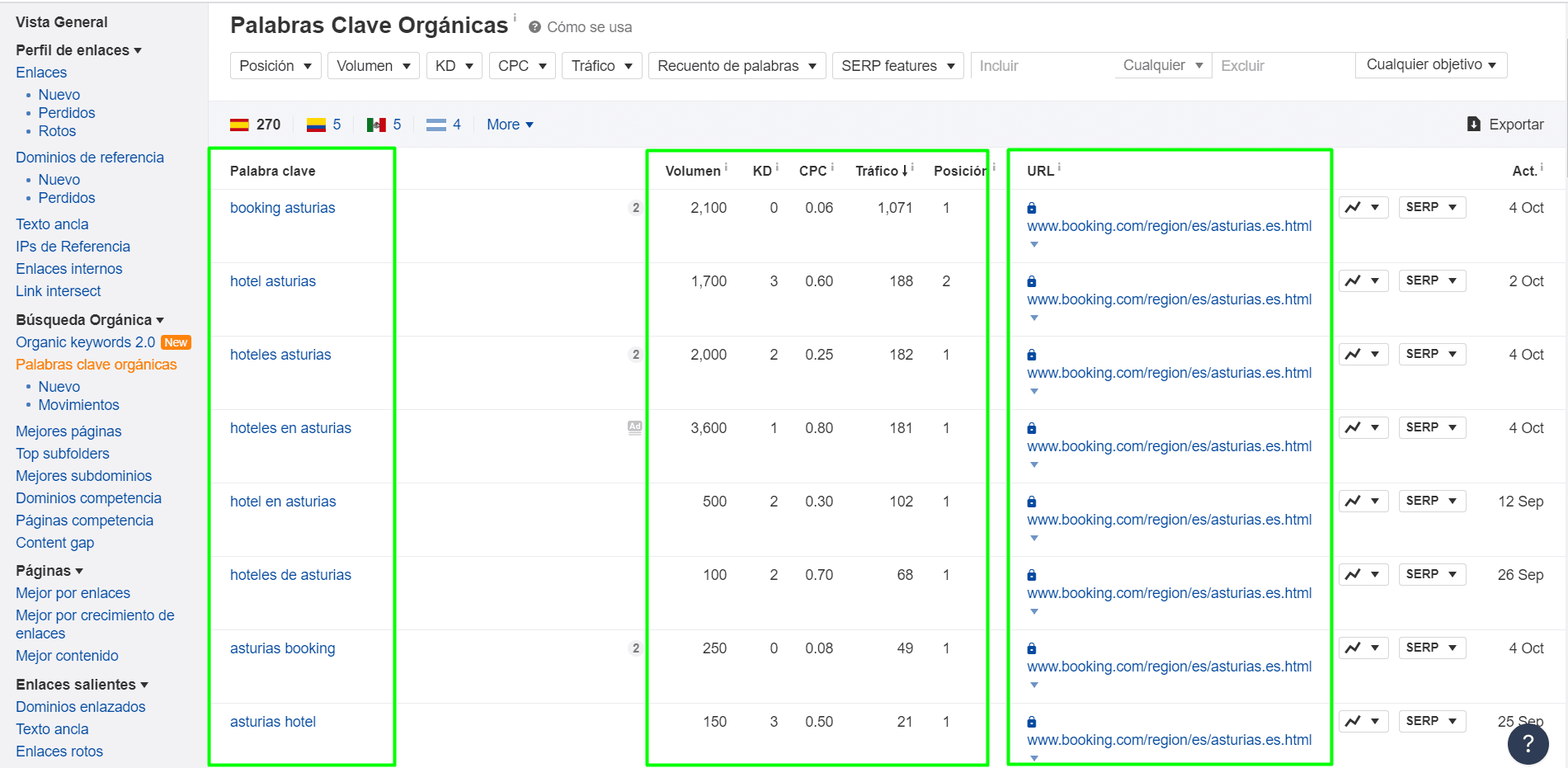
View of the "organic keywords" functionality of Booking.com with Ahrefs
As we see in the image, for the competitor Booking.com, we can extract the keywords that are performing best in terms of traffic metrics, search volume, and SERP position, as well as the difficulty of ranking them through the Keyword Difficulty (KD) metric and the URL where the keyword is located. If we export the list to an Excel file, we can start gathering ideas for our subsequent keyword research.
Similarly to how we extracted the keywords of our competitors, we can also study the external link profile (backlinks) of each of them. To do so, we'll need to click on backlinks (in the SERP interface we saw in the previous step), and the following window will open:
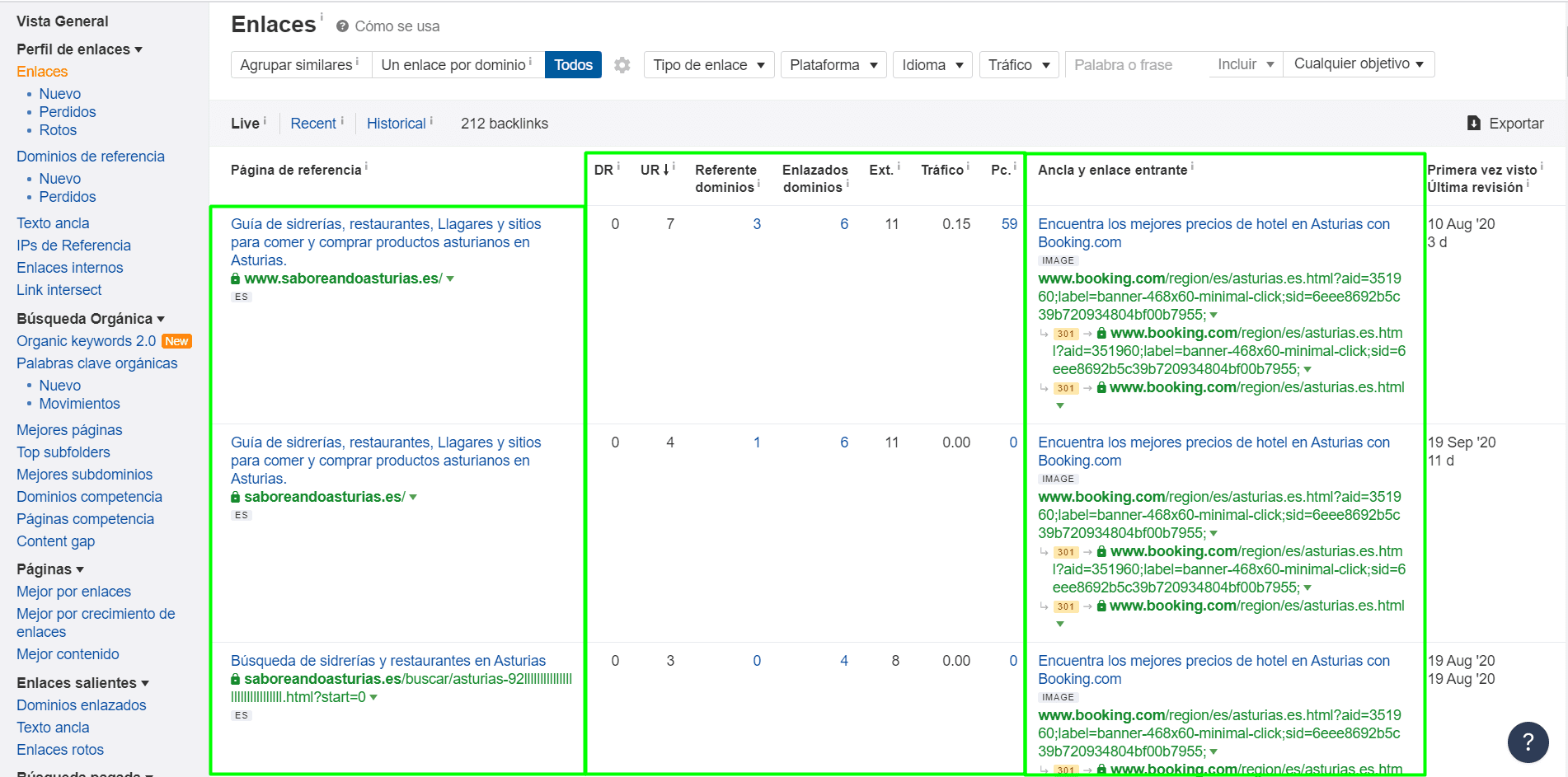
View of the "backlinks" functionality of Booking.com with Ahrefs
Studying our competitors' link profile can give us excellent data about what kind of strategies they are carrying out. Is our competition linking with other websites of similar topic or niche? Do they have affiliate links with bloggers? What type of anchor text do they have in their backlinks? Do they contain the target keyword?
Later on, we'll answer these questions and look at some guidelines for developing an Off Page SEO strategy for hotels.
It's no surprise that both the link profile and the other metrics of these analyzed competitors are very high, considering which websites they are. As we said, the tourism sector is a very competitive niche, so if we want our hotel website to rank for relevant terms, we'll have to look for another formula that manages to aggregate similar or greater search volumes, with keywords that have less competition and are more focused on resolving the search intents of potential clients.
We achieve this through good keyword research. Let's take a look!?
The starting point: Keyword Research
Keyword research is the cornerstone of a hotel SEO strategy. And why is that? For three important reasons:
- Identify and detect opportunity keywords: With these, we'll achieve traffic acquisition and organic visibility through users interested in our content, products, and services in the sector.
- Assigning terms to landing pages: Structuring the website with data on user search patterns and aligning optimization with the content of our landings.
- Hyper-segmenting content: Depending on the nature of the project, we can have transactional, timeless informational content, and others associated with freshness, for example.
Long Tail Strategy
When doing keyword research for hotel SEO, we must avoid using keywords that are very generic and short tail (strings of 1 or 2 words that have many searches and therefore a lot of competition), focus on user experiences and search intents, and opt for long tails. As we've seen, it's a mistake to work and try to rank keywords like "hotels" or "Asturias hotels" since we would be competing with the largest OTAs (Online Travel Agencies), and it would be a waste of time and money.
Let's see how to illustrate it simply:
- Generic searches: *"Asturias hotel" *, "costa verde hotel"
- Semi-generic searches: *"4-star hotel Asturias" *, "cheap hotel Asturias"
- Long tail searches: "romantic hotel with spa Asturias", "New Year's Eve cotillion hotel Asturias"
Therefore, it's about getting very segmented visits through a long tail strategy that helps you achieve highly qualified traffic with high conversion rates (conversion = bookings).
The importance of "Search Intent"
As we mentioned earlier, each person is different and has a different way of searching. Google knows that with each search, the user is at a different moment in the purchase process and therefore their immediate goal is different.
In a first search, the user is gathering information, perhaps to make a purchase later. In a second search, they want to buy now, but they don't know which product or service to choose, so they consult other websites looking for additional information to help them decide... This is how you should think when interpreting a customer journey.
Now let's look at a case applied to the hotel tourism sector:
- Audience: In this stage, the user is in a listening or discovery phase, performing searches like "ideas for traveling with kids" and consulting travel blogs, destination websites, and researching on social media.
- Awareness: In this awareness phase, the user has started shaping their destination and performs mid tail or long tail searches with geographical orientation ("hotels in Paris," "hotels near Disneyland").
- Consideration: Here the user is weighing and evaluating different opinions on hotel websites and travel comparison sites like TripAdvisor.
- Action: This is the conversion stage, where the user's searches are like "Weekend offer magic circus hotel" and they make reservations on OTAs like booking, edreams, atrapalo...
- Advocacy: In the final loyalty stage, the user shares their own reviews on the websites of the hotel where they've spent their vacation and leaves reviews on social networks and different OTAs.
Web architecture: Grouping keywords into SEO-oriented categories
Defining a good web architecture in hotel SEO is the foundation for organizing information, taxonomies and folksonomies, and the different contents that make up the website, as well as for grouping the keywords we've defined in our keyword research.
Hierarchical models or SILO structures are perfect for organizing websites with lots of information. Their structure consists of a main page (home page) under which hang the different sections from the most generic to the most specific. Another benefit of using this structure is that the home page will receive a considerable volume of external links from other websites, which will favor the distribution of *link juice * to the innermost pages (second level, third level...), and in turn will benefit from the internal links received from all its contents.
Therefore, in a SILO structure, URLs must be correctly structured and keep coherence, showing the target keyword that the content is focused on. Let's see an example:
www.mytourismwebsite.com/offers/hotels-asturias/orwww.mytourismwebsite.com/offers/hotels/asturiaswww.mytourismwebsite.com/online-bookings/rural-houses-asturias/orwww.mytourismwebsite.com/online-bookings/rural-houses/asturias/www.mytourismwebsite.com/rooms/hostels-asturias/orwww.mytourismwebsite.com/rooms/hostels/asturias/
As we see, in each level 2 category, we'll nest the corresponding level 3 ones that are closely related to it. This structure will also favor crawlability and indexing by search engines and usability and navigation by users.
Creating valuable, structured, and optimized content (and inspiration for travelers)
It's obvious, but no less important to say that when users are looking for a hotel to book and spend their vacation, they are thinking about the destination. A good hotel SEO strategy is to create a blog where you develop content on topics that narrate experiences about that destination, as it will allow you to reach a much wider audience. It will also allow you to target long tail terms more aligned with the search intents of your target audience.
From SEOcrawl AI, we recommend creating an editorial calendar, where you recurrently publish articles that provide value and serve as inspiration for the user, such as routes, getaways, places of interest, etc.
Local SEO for hotels: Google My Business listing
This strategy is crucial in hotel SEO. At SEOcrawl AI, we recommend creating and optimizing the Google My Business listing for your hotel business for the following reasons:
- It will increase the visibility of your local business: Every time a user performs a search for your hotel with geographical orientation, Google will show your My Business listing in the SERPs.
- Competition: If your business is small or medium-sized and, as is logical, it may be difficult to compete with OTAs and other larger hotels, and you also don't have a large investment for SEO and PPC, having a Google My Business listing will help you compete with them in local results.
- Higher probability of conversion: In tourism businesses, a Google My Business listing can have a gateway for the final transaction, since you can place partner links to online booking websites (Expedia, booking...) or include a "book a room" button, thus providing relevant business data to the user.
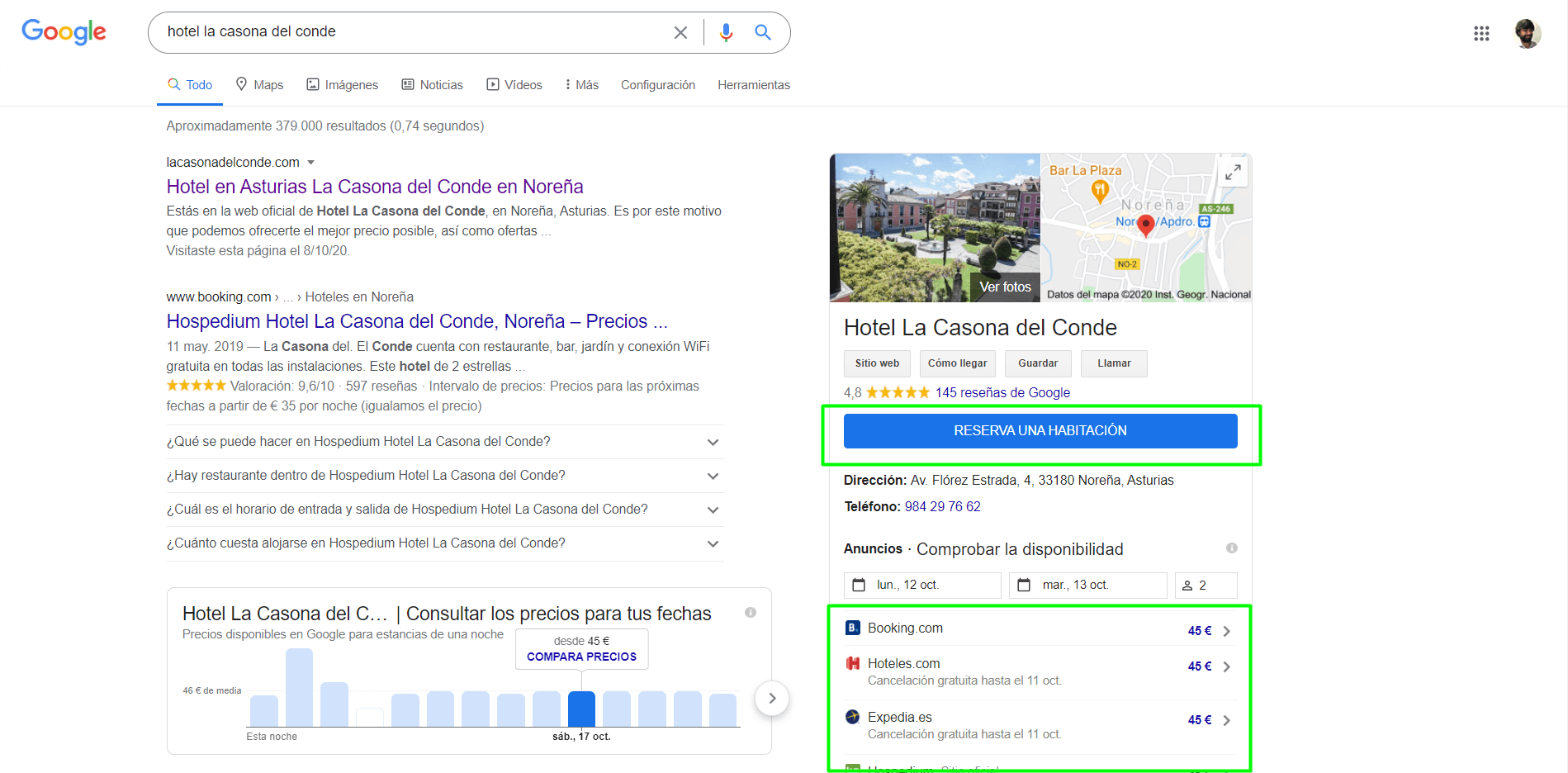
Optimized Google My Business listing of a hotel in Asturias
Mobile-optimized website
If you want your hotel website to rank in the medium to long term in the different search engines, it is essential that it is optimized for mobile devices with a responsive and SEO-friendly design. This is especially important in the tourism sector, as many queries, searches, and reservations are made through mobile search.
Content promotion on social media
Another important strategy in hotel SEO is taking care of your social profiles. As we've seen in the search intent section, users in an initial listening phase consult opinions, reviews, ratings, and of course images on social profiles before considering making a reservation. Also, in a final loyalty (nurturing) phase, if users have had a good experience at your hotel, they will surely leave a positive review, which will favor web traffic to your business and of course you'll have loyal customers who will return later.
From SEOcrawl AI, we recommend that you update and promote the content you publish on your website on social media. It will greatly help your local business and give it visibility.
Inbound link strategy to boost Off Page SEO and blogger affiliation
Last but not least for our hotel SEO strategy is through "inbound" link building campaigns to boost the domain authority of our website.
There are excellent tools on the market such as Link Affinity, which allow you to find prospects and authoritative domains of websites with topics related to your business, and where you can contact them to get a "dofollow" link to your site. Similarly, with Ahrefs you can analyze your competitors' profile, see which domains are linking to them, and try to get links from those domains.
Another interesting resource is through blogger affiliation. How does this method work? Through an affiliate marketing strategy where, through marketplaces, you can register and affiliate with a partner's product or service, which will return a link to your website in exchange for a commission.
In short, having an Off Page SEO strategy for your business will help you increase your site's authority and climb positions in search engine rankings in this highly competitive niche that is the hotel sector.
And that's it for this hotel SEO guide! We hope it has been useful and that you can apply it in your business starting today. If you have any questions or suggestions you want to share with us, we'll be happy to answer. Best regards and see you next time!
Author: David Kaufmann

I've spent the last 10+ years completely obsessed with SEO — and honestly, I wouldn't have it any other way.
My career hit a new level when I worked as a senior SEO specialist for Chess.com — one of the top 100 most visited websites on the entire internet. Operating at that scale, across millions of pages, dozens of languages, and one of the most competitive SERPs out there, taught me things no course or certification ever could. That experience changed my perspective on what great SEO really looks like — and it became the foundation for everything I've built since.
From that experience, I founded SEO Alive — an agency for brands that are serious about organic growth. We're not here to sell dashboards and monthly reports. We're here to build strategies that actually move the needle, combining the best of classical SEO with the exciting new world of Generative Engine Optimization (GEO) — making sure your brand shows up not just in Google's blue links, but inside the AI-generated answers that ChatGPT, Perplexity, and Google AI Overviews are delivering to millions of people every single day.
And because I couldn't find a tool that handled both of those worlds properly, I built one myself — SEOcrawl AI, an enterprise SEO intelligence platform that brings together rankings, technical audits, backlink monitoring, crawl health, and AI brand visibility tracking all in one place. It's the platform I always wished existed.
Discover more content about this author
On-page SEO is everything you control on a page: content, title, meta description, headings, URL, images and internal links. Here is a checklist element by element, an audit process and what changes with AI Overviews and AI Mode.