What Is Domain Authority & How Is It Calculated?
Domain Authority predicts how well a site will rank, but it is not a Google ranking factor. Here is what DA actually measures, how it compares to DR and Authority Score, and which metrics deserve your attention instead.
Domain Authority (DA) is a proprietary metric developed by Moz that scores a domain's predicted ability to rank on a scale from 1 to 100. Google does not use it as a ranking factor and never has. DA is a third-party benchmark: useful for comparing sites in the same niche, not for optimizing your way up Google's results.
If you have been asked for your DA in a link building pitch or a competitor analysis, this guide covers what the score measures, how it is calculated, and why the numbers that actually move your rankings live in Google Search Console, not in a third-party tool.
What Domain Authority is (and what it is not)
Domain Authority is a 1 to 100 score created by Moz that predicts how likely a website is to rank in search results. The scale is logarithmic, which means the gap between scores grows as you climb: going from 10 to 20 takes far fewer links than going from 70 to 80.
DA is built for comparison, not absolute judgment. A score of 35 might be competitive in a local niche where rivals sit at 20, but weak in a crowded vertical where everyone scores above 60. The number only makes sense next to the sites you actually compete with.
Three things to keep in mind:
- DA is predictive: it estimates ranking likelihood, it does not explain it.
- DA is relative: your score matters only compared to competitors in your keyword space.
- DA fluctuates: Moz retrains its model and refreshes its link index, so your score can shift even if your backlinks have not changed.
How Domain Authority is calculated
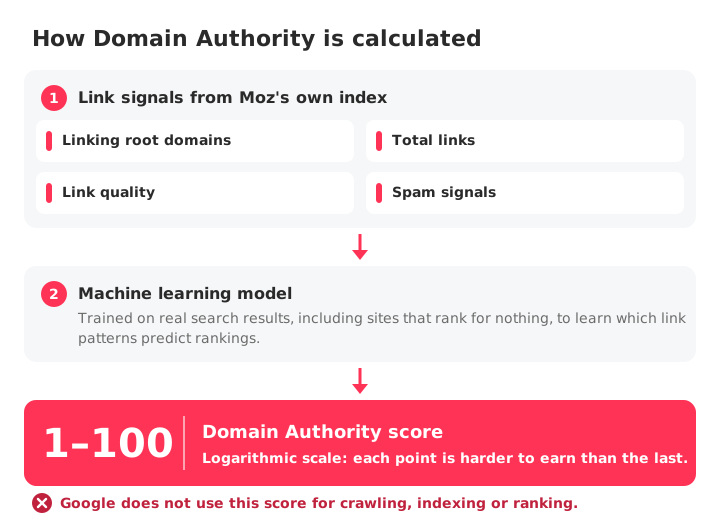
Moz calculates DA with a machine learning model trained on real search results. The model looks at which domains rank, and which don't, and learns which link patterns best predict ranking. It then condenses those signals into a single score on the 1 to 100 scale.
The main inputs:
- Linking root domains: the number of unique domains linking to your site. More unique referring domains generally means a higher score.
- Total links: the overall number of links pointing at the domain, which matters less than how many distinct sites they come from.
- Link quality: links from trusted, well-linked and topically relevant sites carry more weight than links from random or low-quality pages.
- Spam signals: the model discounts patterns associated with manipulative linking, such as link networks or unnatural anchor text.
You may still read that DA is built from MozRank and MozTrust. Those were older, static Moz metrics. Since Domain Authority 2.0 launched in March 2019, the score comes from a trained model, and that version added sites that rank for nothing to the training data so high scores reflect real ranking ability.
DA operates at the domain level, not the page level. A single strong page on a weak domain will not raise the overall score much, and a weak page on a strong domain will not drag it down. Moz has a separate metric, Page Authority, for scoring individual pages.
Because the scale is logarithmic, each point gets harder to earn. The difference between DA 10 and DA 20 represents far less link growth than the difference between DA 70 and DA 80.
Domain Authority is not a Google ranking factor
This is the most persistent myth in SEO, so here is the direct answer: Google does not use Domain Authority as a ranking signal. DA is built from Moz's link index and Moz's algorithm. Google's ranking systems use their own signals: links, relevance, search intent, content quality, page experience and many more.
Google has said so on the record again and again. John Mueller, Google Search Advocate, put it bluntly in 2020: "Google doesn't use Domain Authority at all when it comes to Search crawling, indexing, or ranking." The statements collected by Search Engine Journal go back to 2016, and even Moz describes DA as a predictive metric with no effect on search results.
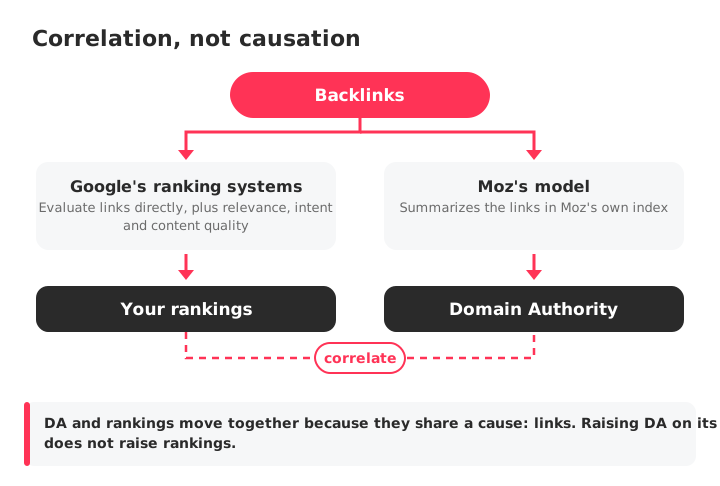
The confusion comes from the fact that DA correlates with rankings. Sites with a high DA tend to rank well because they tend to have strong, diverse backlink profiles, and links do matter to Google. But the connection runs through the links, not through DA. Google evaluates links directly; it does not need a third-party score to summarize them.
The practical takeaway: raising your DA does not guarantee better rankings. You can inflate DA with links that Google ignores, and you can rank well with a modest DA if your on-page SEO and content match what searchers want. Treat DA as a benchmark for link building, not as a KPI for search performance.
DA vs DR vs Authority Score: what is the difference?
Three major SEO tools each publish their own authority score. They measure similar things, mostly backlink strength, but use different data sources and different formulas, so the numbers are not interchangeable.
| Metric | Created by | Scale | What it estimates | Main inputs |
|---|---|---|---|---|
| Domain Authority (DA) | Moz | 1 to 100 | Predicted ranking ability | Linking root domains, total links, link quality, spam signals |
| Domain Rating (DR) | Ahrefs | 0 to 100 | Strength of the backlink profile | Unique referring domains with followed links, their own DR, how many sites each one links to |
| Authority Score (AS) | Semrush | 1 to 100 | Overall domain quality | Link power, estimated organic traffic, spam factors |
A single domain can have DA 45, DR 38 and an Authority Score of 52, all describing the same backlink profile through different lenses. None of these scores is a Google ranking factor. All three are proprietary benchmarks designed to help you compare domains.
The sensible approach: pick one tool, use its score consistently for comparison, and resist switching between metrics to find the one that makes your site look best.
What is a "good" Domain Authority score?
There is no universal good DA. A score is only meaningful relative to your competitors. The useful question is not "what is a good DA?" but "how does my DA compare to the sites I need to outrank?"
Rough ranges, with the caveat that these are general benchmarks:
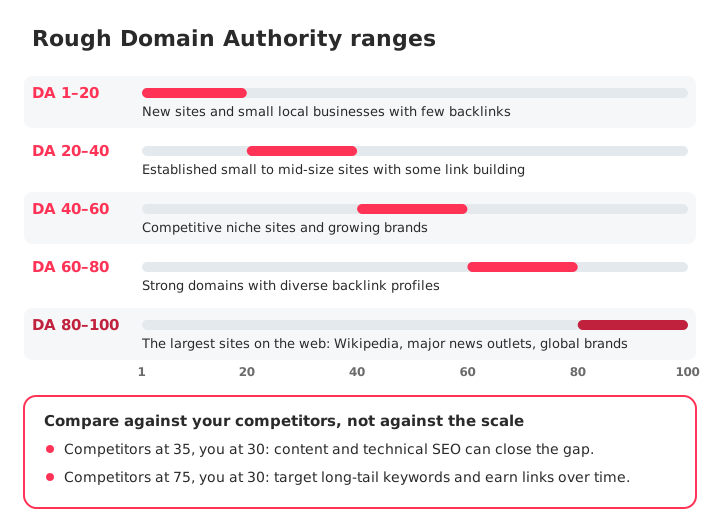
- DA 1 to 20: new sites or small local businesses with few backlinks.
- DA 20 to 40: established small to mid-size sites with some link building.
- DA 40 to 60: competitive niche sites and growing brands.
- DA 60 to 80: strong domains with diverse backlink profiles.
- DA 80 to 100: the largest sites on the web, such as Wikipedia, major news outlets and global brands.
If your competitors average DA 35 and you sit at 30, you are close enough that content quality and technical SEO can close the gap. If they average 75 and you are at 30, you need a different plan: look at the SERP for less competitive long-tail keywords where raw link strength matters less, and invest in content that earns links over time.
DA also tends to be higher for older domains, because they have had more time to accumulate links. A new site at DA 15 is not underperforming. It is at the starting line.
How to check DA (and what to track instead)
You can check any domain's DA with Moz's free Domain Analysis tool, its Link Explorer or the MozBar browser extension. Several other SEO tools display DA next to their own metrics.
But keep in mind that DA is a proxy. It approximates link strength, which is one of many things Google looks at. Whether your pages actually rank is visible in Google Search Console: real clicks, impressions, average position and click-through rate, broken down by query and by page.
Tracking DA tells you your link profile is growing. Tracking your Search Console data tells you whether that growth is turning into rankings and traffic. The second is what pays the bills.
SEOcrawl AI brings those numbers together. Its SEO Dashboard unifies Search Console and GA4 data in one place, so you can see clicks, impressions and positions by page and keyword over time, and its AI Tracker monitors how your brand appears in ChatGPT, Gemini, Perplexity and other AI search engines. That way you watch the metrics tied to actual traffic, not a score invented by a tool company.
How to actually improve your authority
Improving DA and improving real search performance overlap, but they are not the same thing. Here is what moves both:
- Earn links from relevant, trusted sites. One link from a site that ranks in your niche does more than ten from unrelated blogs.
- Create content that attracts links on its own. Original data, free tools and genuinely useful resources earn links without outreach.
- Build topical authority. Covering a subject in depth across connected pages shows expertise to both Google and readers.
- Keep an eye on your link profile. Most low-quality links are simply ignored by Google, so you rarely need to act. Google recommends the disavow tool only when you have a manual action or a large number of paid or spammy links you cannot remove.
What does not work: buying links, joining link exchanges or treating DA as a target. These tactics can inflate the score without improving search performance, and links bought to manipulate rankings go against Google's spam policies.
FAQs
How is Domain Authority calculated?
Moz runs data from its own link index through a machine learning model trained on real search results. The model weighs signals such as the number of unique linking root domains, the total number of links, the quality of those links and spam patterns, and turns them into a single score from 1 to 100. The scale is logarithmic, so each point is harder to earn than the last.
Is Domain Authority a Google ranking factor?
No. Domain Authority is a Moz metric, and Google has said many times that it does not use it, or any other third-party authority score, for crawling, indexing or ranking. DA correlates with rankings because it approximates backlink strength, but Google evaluates links directly.
What is a good Domain Authority score?
There is no universal good score. DA only makes sense next to the sites you compete with: if the pages outranking you sit around DA 30 and you are at 25, you are within range. If they sit around 70, a different keyword strategy will serve you better than chasing the number.
DA vs DR: what is the difference?
DA (Domain Authority) is Moz's metric and runs from 1 to 100. DR (Domain Rating) is Ahrefs' metric and runs from 0 to 100. Both summarize backlink strength, but they use different link indexes and different formulas, so the numbers are not comparable. Pick one and use it consistently.
How can I increase my Domain Authority?
Earn links from relevant, trusted sites, publish content that attracts links on its own and build topical depth. Those actions raise DA and also improve real search performance. Buying links or joining link schemes can inflate the score without helping rankings, and can break Google's spam policies.
Author: David Kaufmann

I've spent the last 10+ years completely obsessed with SEO — and honestly, I wouldn't have it any other way.
My career hit a new level when I worked as a senior SEO specialist for Chess.com — one of the top 100 most visited websites on the entire internet. Operating at that scale, across millions of pages, dozens of languages, and one of the most competitive SERPs out there, taught me things no course or certification ever could. That experience changed my perspective on what great SEO really looks like — and it became the foundation for everything I've built since.
From that experience, I founded SEO Alive — an agency for brands that are serious about organic growth. We're not here to sell dashboards and monthly reports. We're here to build strategies that actually move the needle, combining the best of classical SEO with the exciting new world of Generative Engine Optimization (GEO) — making sure your brand shows up not just in Google's blue links, but inside the AI-generated answers that ChatGPT, Perplexity, and Google AI Overviews are delivering to millions of people every single day.
And because I couldn't find a tool that handled both of those worlds properly, I built one myself — SEOcrawl AI, an enterprise SEO intelligence platform that brings together rankings, technical audits, backlink monitoring, crawl health, and AI brand visibility tracking all in one place. It's the platform I always wished existed.
Discover more content about this author
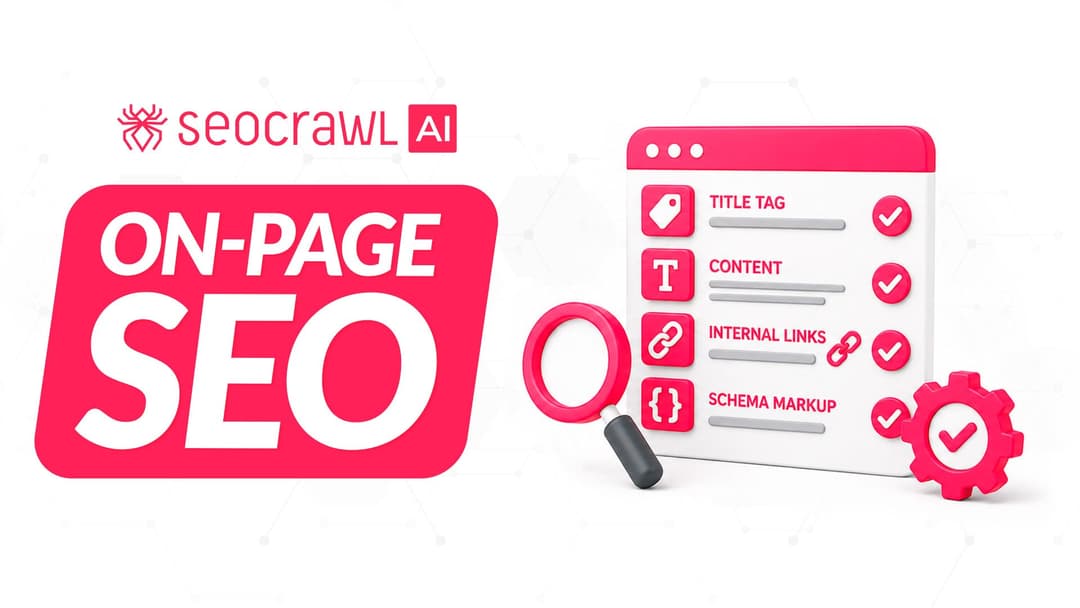
On-page SEO is everything you control on a page: content, title, meta description, headings, URL, images and internal links. Here is a checklist element by element, an audit process and what changes with AI Overviews and AI Mode.